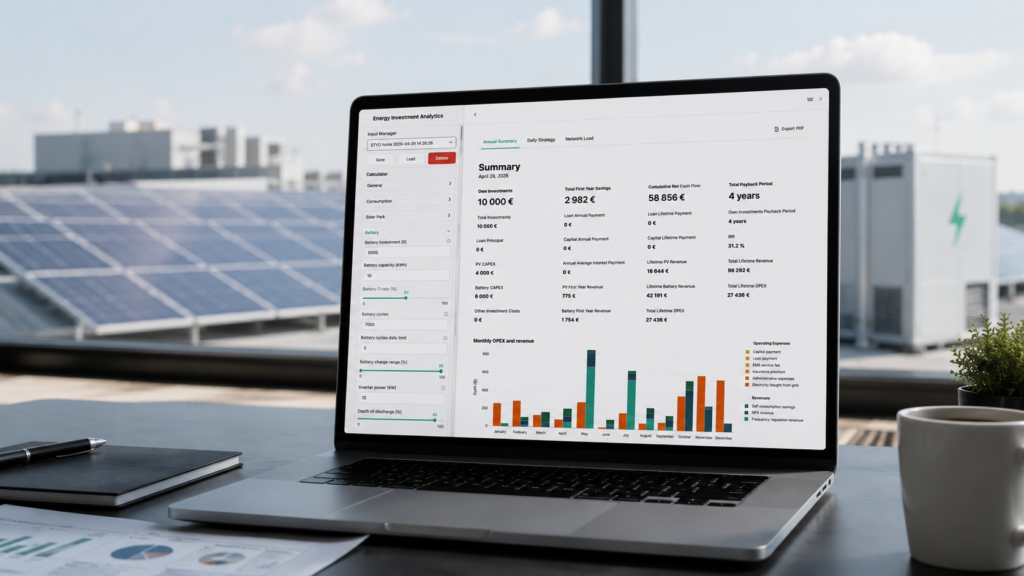
Every solar and battery sales engineer in the Baltics knows the moment: you’re twenty minutes into a meeting with a promising customer. A logistics company, a dairy farm, a developer planning solar on a new commercial rooftop. And they ask the question that decides everything: so, what’s the payback time?
You have two options: give a quick number that you’ll have to walk back later, or promise a proper model and disappear for days or weeks into a spreadsheet. Neither is a good answer in 2026.
STYO is the tool we built to fix that. It’s an energy investment analytics platform that turns a PV and BESS proposal into a complete, defensible financial model – in minutes, not days. It’s built on real Nord Pool price history, Baltic grid tariffs, and frequency-market data.
Honest payback maths got harder
A few years ago, everyone knew that 45 €/MWh was the ballpark average electricity price. Nord Pool day-ahead prices in Estonia, Latvia, and Lithuania swing dramatically between hours, days, and seasons – sometimes negative, sometimes ten times the annual average. A flat-price model hides both the risk and the upside.
Three structural changes have made the market richer and the maths heavier at the same time:
- The Baltic states joined the Continental European synchronous area in February 2025, which opened up aFRR and mFRR frequency reserves as real revenue streams for batteries, but only for sales teams who can model them properly.
- Elering moved to 15-minute imbalance settlement in March 2025, rewarding smart battery dispatch and punishing models that still think in hourly averages.
- Baltic distribution tariffs move the economics enough that picking the wrong package can wipe out a year of self-consumption savings.
Add BESS degradation, hybrid inverter logic, negative-price protection, and financing structure, and the back-of-the-envelope calculation that used to fit on one page now needs a serious simulation behind it.
That is the gap STYO is built for.
What STYO actually is?
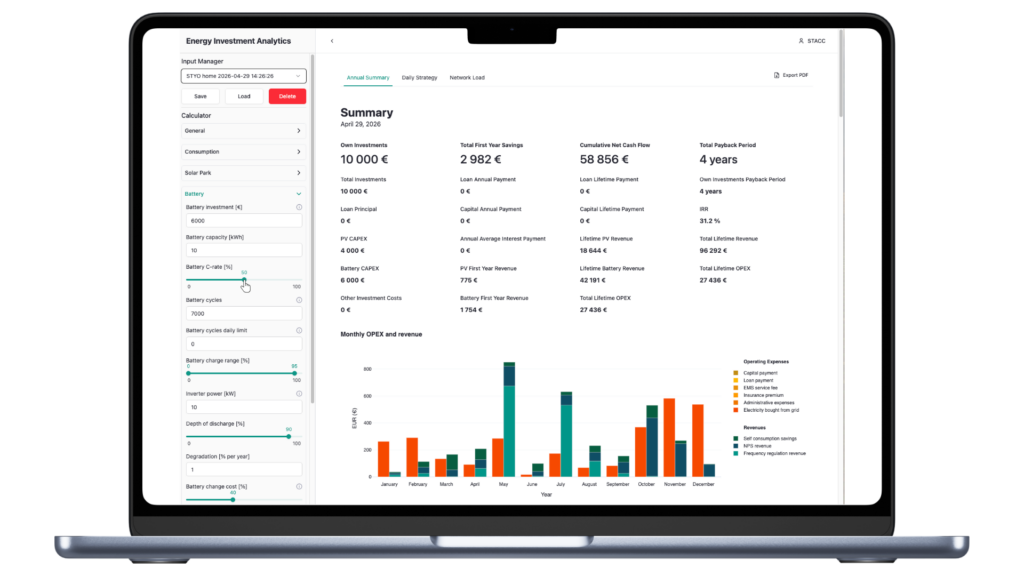
STYO is a web platform where a sales engineer enters a customer’s project parameters and gets back a complete financial model: payback period, IRR, cumulative cash flow, monthly cost comparison, plus a range of other statistics. There are around sixty configurable parameters, organised so you can fly through the obvious ones and slow down on the ones that matter. One click exports the whole thing to XLSX and PDF for the customer, their bank, or a financing partner – in a format familiar in real financing discussions.
Example: an industrial customer
Imagine a manufacturing client looking at a 200 kWp rooftop PV system with a 150 kWh battery. Here’s what a STYO session looks like.
The sales engineer drags in the customer’s 15-minute or hourly consumption data (XLSX or CSV). If the customer can’t share data yet, STYO includes built-in standard load profiles – from residential to industrial – to keep the conversation moving.
Next, the CAPEX numbers: investment for the PV array, the battery, inverter power, expected degradation, and cycle limits. The grid connection tab takes the customer’s amperage and lets you pick the right tariff package from the built-in catalogue – Elektrilevi and Võrk 4, say, for an Estonian customer with a significant peak demand charge.
Then the interesting part. Toggle on aFRR/mFRR participation, set a participation rate, and add the aggregator’s fee. Add a renewable subsidy if one applies. Set a 70% loan share at the bank’s current rate, leave the rest as equity.
Click Calculate. In a few seconds, you have:
- A headline payback period (total and on the customer’s own investment) and an IRR
- First-year and lifetime revenue split by source: self-consumption savings, day-ahead arbitrage, aFRR/mFRR upward and downward regulation, load shifting
- Expenses broken out: capital and loan payments, transmission fees, EMS service, insurance, maintenance, energy used for BESS optimisation
- A monthly cost comparison (before vs after), a cumulative cash flow chart, and a battery view showing cycle use against the warranty
- A CO₂ overview: how much green energy the customer consumes directly, how much via the battery, and the optimised footprint against the baseline
If the customer says, “What about 200 kWh of battery instead?”, you change one number and recalculate while they watch. Save the scenario under a name. Generate three variants for the same client by lunchtime.
What’s under the hood?
STYO runs a simulation against real historical Nord Pool day-ahead and Baltic frequency-market data. The Estonian, Lithuanian, and Latvian distribution tariff catalogue is built in and kept current. Financing logic – loan duration, interest rate, equity share, subsidy timing – is modelled explicitly rather than averaged away. The aim is a model a sales engineer can defend in front of a customer’s CFO, not a glossy number.
What changes for the sales team?
The biggest shift isn’t speed for its own sake. It’s what the speed makes possible. When recalculating a proposal takes three minutes instead of three hours, the sales engineer stays in the conversation with the customer – iterating on battery size, financing structure, tariff package, frequency-market participation – instead of going dark for days or weeks.
The output is also a different artefact. An XLSX or PDF generated by STYO is detailed enough to send to the customer’s bank or financial advisor without rework. That tends to shorten the gap between “interesting proposal” and “signed contract”.
Try it on a real project
STYO is live at styo.eu, and you can request a demo account via the form. If you’d like a walkthrough with data from one of your own customers, or simply want to talk through the solution, get in touch with Siim Meeliste at siim.meeliste@stacc.ee.
The Baltic energy transition is moving fast. In this market, the best answer is no longer the fastest guess. It’s the fastest defensible model. The sales teams who can answer “What’s my payback?” honestly, in the room, are the ones who will close the projects that build it.