The energy sector is changing fast. Daily headlines about green transition strategies, geopolitical shifts, and supply security make that clear. The transition to a carbon-neutral economy and local energy independence both depend on our ability to integrate renewables into existing power grids.
Today, grid operators manage renewable energy influx using a “static maximum” approach. Connection permits are granted based on the assumption that every producer will operate at 100% capacity at all times. In reality, this vastly overestimates actual production and locks green energy out of the grid.
To bridge this gap, our client MarkeDroid is developing a forecast-based dynamic optimisation system: a real-time, data-driven alternative that uses existing infrastructure more efficiently. We are setting sail to test it in Hiiumaa as part of MarkeDroid’s applied research project, “Unlocking renewable potential through forecast-based microgrid optimisation”, funded by Enterprise Estonia through the Applied Research Programme.
The project brings together three organisations. MarkeDroid, whose live Virtual Power Plant system runs across 12 countries and serves 1,000+ clients, provides the IoT hardware, behind-the-meter optimisation, and the prosumer interface. STACC leads the R&D on grid simulation, machine learning, and allocation algorithms, investigating whether static connection rules leave grid capacity untapped. Elektrilevi, Estonia’s largest distribution network operator, contributes the real-world testbed: Hiiumaa’s grid and the critical data that comes with it.
What is a Microgrid?
You may have heard the term “microgrid” thrown around in energy circles, but what does it actually mean?
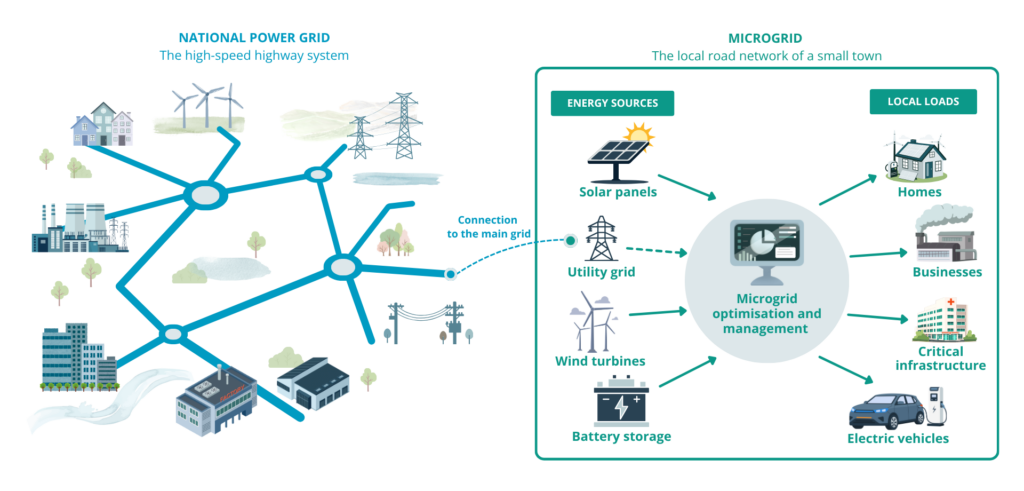
Think of the national power grid as a high-speed highway system. A microgrid is like the local road network of a small town. It is usually connected to the highway, but it has its own power sources (solar panels and wind turbines) and its own consumers (homes and businesses).
Microgrid optimisation is the traffic logic for that small town. The roads were built when there were fewer cars and enough room for everyone to drive at once. Today, the needs have changed and more people would like to enter traffic. Optimisation uses data to say: “The road is clear right now, you can drive safely.”
Why Hiiumaa?
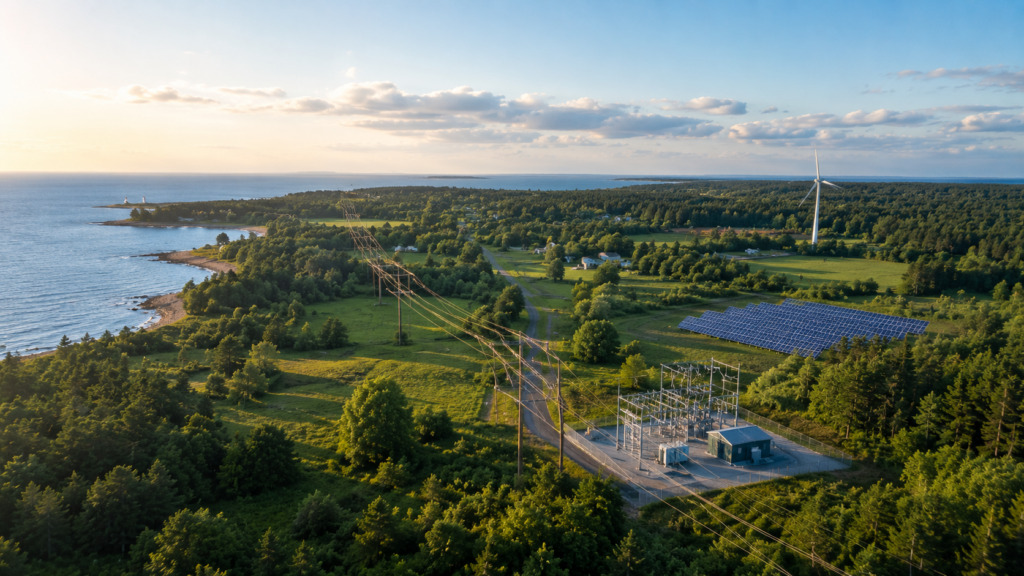
As Estonia’s second-largest island, Hiiumaa is a natural laboratory for grid optimisation. It has strong potential for both wind and solar energy, but its connection to the mainland is limited. If the island could better balance its own production and consumption, it would become more resilient and less dependent on the subsea cables linking it to the rest of the country. This makes Hiiumaa a valuable test case: its grid has clear physical constraints, variable renewable generation, and a manageable scale for validating a dynamic optimisation approach.
Piloting the system in Hiiumaa is not just about helping a few local solar parks. It is about proving that a decentralised grid can be managed more intelligently. If the dynamic approach can support stable operation in Hiiumaa’s grid, it can be extended to other microgrids with local generation potential.
Under the Hood: The Data Science Solution
STACC’s role is to build the brain of this dynamic forecasting system. We aim to investigate whether we can accurately predict and allocate unused grid capacity to increase renewable energy integration without compromising grid stability. To move from a “worst-case” (static maximum) approach to a dynamic one, we are following a three-stage technical roadmap.
A Digital Twin of the Power Grid
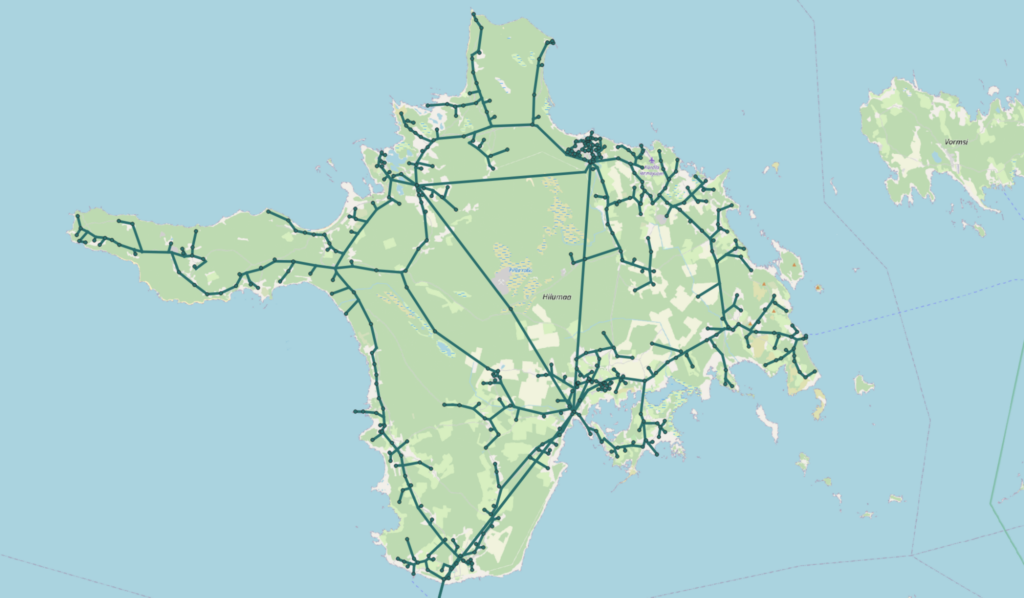
The first step is to build a digital twin of the power grid. We remove unnecessary detail from the power grid data, keeping the skeleton of the network as a simplified graph: critical junctions and the power lines connecting them. In addition, each object carries its own specific characteristics, including voltage limits, resistance, and capacity. These parameters define the grid’s physical limits and form the basis for simulating how electricity flows through the actual wires without touching a single switch. It is a virtual sandbox where we can safely test the grid’s limits.
Predicting “Free Space” with Machine Learning
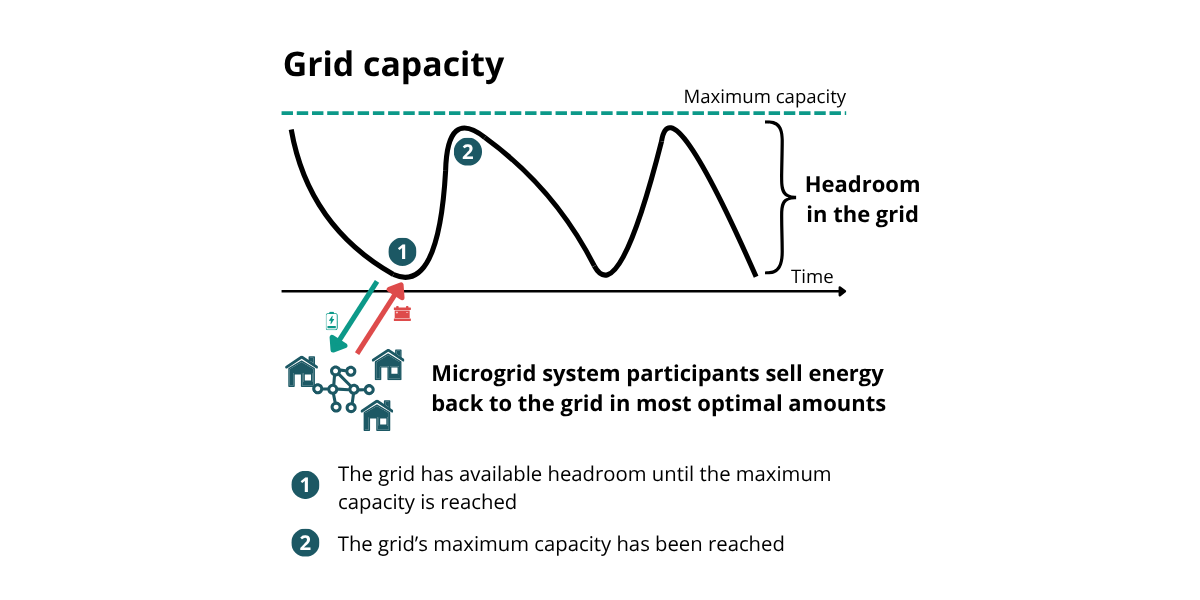
Once the grid is digitised, we need to know how much traffic it can actually handle. This is where data science does the heavy lifting. Our hypothesis is that the static maximum approach leaves a lot of space on the table. Using advanced machine learning, we aim to predict the free capacity at each substation with much more precision than assuming maximum production from all producers. In a country like Estonia, where peak solar conditions are the exception rather than the rule, much of that capacity may be sitting idle. Our goal is to quantify how much capacity is available in every 15-minute interval.
Fair Allocation
If there is free space that lets producers sell more energy, we also need to decide who gets to use it and when. We are building an allocation model that distributes capacity fairly and transparently by using objective, data-based criteria. This helps to ensure that both large wind farms and local prosumers get fair access to the market based on the grid’s real-time state.
Before the live pilot, the models will be validated against historical data to compare predicted capacity with actual operating conditions and known constraints. Historical testing will provide an initial proof of concept for the dynamic system and establish baseline expectations for available capacity before piloting the system in Hiiumaa.
From Data to Testing: The Hiiumaa Pilot
Once the system is built and historical data indicates where hidden capacity may exist, MarkeDroid takes the helm for the most critical phase: the live pilot. The system will be tested in the Hiiumaa microgrid in collaboration with Elektrilevi, Estonia’s largest distribution network operator, with real-time results gathered under shifting weather and demand.
During the pilot, we want to know:
- Can we feed more renewable energy into the grid? Is there a measurable rise in renewable energy flowing into the grid compared to today’s static limits?
- Does grid utilisation improve? Is the “energy highway” spending less time empty while cars wait at the entrance?
- Do stability and resilience improve? Are there fewer overload incidents, outages, or curtailment events where producers are forced to shut down?
The “Win-Win-Win-Win” Scenario
If we succeed, this is not just a technical fix, but a four-way win:
- For producers: new producers get a foot in the door, earning revenue during newly unlocked “dynamic windows” of capacity.
- For consumers: more local renewable energy means a more balanced, stable grid, and over time, more competitive prices and a reliable supply.
- For network operators: physical grid upgrades are slow and expensive. Squeezing more out of existing infrastructure saves money and accelerates progress toward EU climate goals.
- For the environment: every kilowatt of unlocked “hidden capacity” is a kilowatt that can come from solar or wind instead of fossil fuels.
Conclusion
Exciting months lie ahead as we dig into grid digitalization, capacity prediction, and allocation algorithms to test these hypotheses. If we succeed, we have taken an important step from a world of static limits to one of dynamic intelligence, and the results from Hiiumaa will provide a proof of concept for a more dynamic way of managing grid capacity.
Stay tuned as we explore data-driven power grid optimisation.